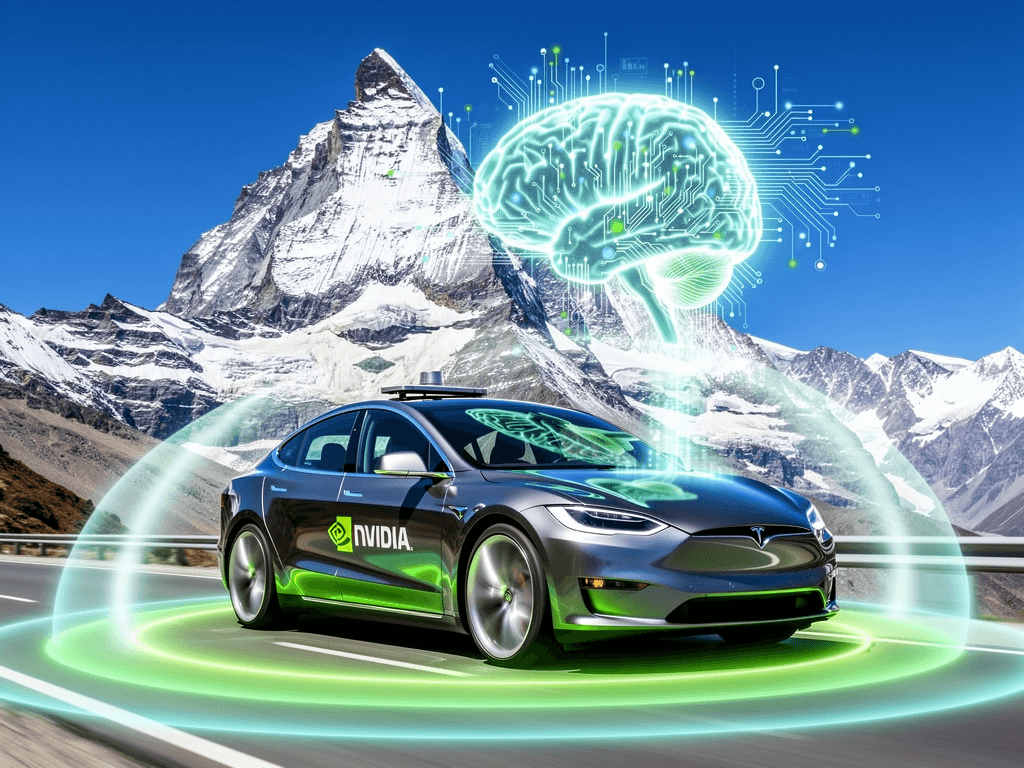
NVIDIA Releases Alpamayo-R1: Reasoning AI for Autonomous Driving
On December 1, 2025, NVIDIA released Alpamayo-R1—a reasoning model designed specifically for autonomous driving. Built on NVIDIA's Cosmos-Reason architecture, the model represents a shift toward AI systems that deliberate before acting.
The release includes open-source code, model weights, and a new "Cosmos Cookbook" with implementation guides.
What Makes Alpamayo-R1 Different
Traditional autonomous driving systems use reactive perception: detect obstacle, brake. Alpamayo-R1 adds a reasoning layer that considers multiple factors before deciding:
- What is the obstacle?
- What might it do next?
- What are the consequences of different responses?
- What's the safest action given uncertainty?
This deliberative approach mirrors how human drivers process complex situations. A pedestrian at a crosswalk requires different reasoning than a plastic bag blowing across the road, even if both register as obstacles.
The Cosmos-Reason Foundation
Alpamayo-R1 builds on NVIDIA's Cosmos platform—a suite of world foundation models for physical AI. The Cosmos-Reason variant specifically targets decision-making in embodied systems.
Key capabilities:
- Chain-of-thought reasoning: Generates explicit reasoning steps before conclusions
- Uncertainty quantification: Expresses confidence levels in predictions
- Multi-step planning: Considers sequences of actions, not just immediate responses
- Physical world understanding: Trained on data representing real-world physics
Why This Matters for Level 4 Autonomy
Autonomous driving levels range from 0 (no automation) to 5 (full autonomy everywhere). Level 4 represents full autonomy within a defined operational domain—specific routes, weather conditions, or geographic areas.
The gap between Level 3 (conditional automation) and Level 4 involves handling edge cases: unusual situations not covered by training data. Reasoning models address this by generalizing from principles rather than memorizing scenarios.
Example edge cases requiring reasoning:
- Emergency vehicles approaching from unexpected directions
- Construction zones with contradictory signals
- Pedestrians behaving unpredictably
- Weather conditions affecting sensor reliability
Alpamayo-R1 aims to handle these situations through deliberation rather than pattern matching.
Open Source Release
NVIDIA released Alpamayo-R1 with:
- Full model weights on Hugging Face
- Source code on GitHub
- The "Cosmos Cookbook"—implementation guides and examples
- Integration documentation for NVIDIA Drive platform
The open-source approach accelerates industry adoption. Companies developing autonomous systems can build on NVIDIA's architecture rather than developing reasoning capabilities from scratch.
The Cosmos Cookbook
NVIDIA's new resource collection includes:
- Step-by-step deployment guides
- Fine-tuning recipes for specific vehicle types
- Simulation integration tutorials
- Safety validation frameworks
- Edge case handling patterns
The cookbook targets engineering teams implementing autonomous systems. Practical documentation reduces the gap between research models and production deployment.
Industry Context
Autonomous driving has progressed slower than optimistic 2020-era predictions. Full self-driving remains elusive despite billions in investment. The challenge isn't perception—modern systems see well. The challenge is judgment.
Reasoning models like Alpamayo-R1 attack the judgment problem directly. Rather than training on every possible scenario, they aim to reason about novel situations using general principles.
Competitors pursuing similar approaches:
- Waymo's foundation models for driving
- Tesla's neural network planners
- Cruise's prediction and planning systems
- Aurora's safety-focused architectures
Practical Implications
For AV Companies: A capable reasoning model available under open terms. Integration with NVIDIA hardware provides optimization advantages.
For Researchers: Open access to frontier autonomous driving AI. Academic teams can study and improve reasoning approaches.
For Regulators: Explicit reasoning chains provide interpretability. When an autonomous vehicle makes a decision, the reasoning is visible and auditable.
For Timeline Expectations: Reasoning models are necessary but not sufficient for Level 4. Alpamayo-R1 addresses one bottleneck among many.
What's Next
NVIDIA positions Cosmos as an evolving platform. Alpamayo-R1 is one component in a broader physical AI strategy. Future releases will likely include:
- Additional reasoning model variants
- Robotics-specific versions
- Simulation and testing tools
- Safety certification frameworks
The autonomous driving industry continues its slow march toward Level 4. Alpamayo-R1 removes one obstacle. Many remain.